Introducing Oasis 3: First Interactive World Model for Physical AI
Today, we’re introducing Oasis 3 — Decart’s flagship interactive world model, a major step towards a future where robots are an everyday reality.
Robots are about to be everywhere: driving our roads, working in our warehouses, helping in our homes. The bottleneck isn't ambition or hardware. It's training: a robot has to experience the world, in all its complexity and danger, before it can be trusted to act in it.
Today we're launching Oasis 3, a generative world model built for physical AI, starting with autonomous vehicles. It generates infinitely diverse, hyper-realistic, interactive environments from a single prompt — and it's the first world model accessible by API, live from day one. If you're training robots, you can start using it today.
/A.01
Why Do World Models Matter?
Robots, like people, learn by example and by experience — trial, error, and feedback. Watching demonstrations is not enough; a robot has to act, fail, and try again. In other words, robot learning needs to be closed-loop: the robot acts, the world responds, and the robot learns from what happens next.
The real world is a terrible place to do that. It's slow, expensive, and unsafe — and it almost never serves up the situations that matter most. The hardest and most important part of training a robot is exposure to rare, long-tail events: the child chasing a ball into a snowy street, the truck running a red light at dusk. You can't schedule those in the real world, and you wouldn't want to.
So the industry turned to simulation. Classic simulators were a great first step, but they have three structural problems:
- Scale: every environment takes hundreds of expert hours to hand-build, so coverage of the real world's diversity is permanently out of reach.
- Visual Sim2Real gap: their graphics look closer to video games than to reality, so what a robot sees in simulation doesn't match what its cameras will see on the road.
- Physical Sim2Real gap: the physical accuracy of simulators falls short of realism, making it hard for robots trained in simulators to be deployed in real-world settings.
What robots actually need is something else: environments that are realistic enough to transfer to the real world, interactive enough to learn from in a closed loop, diverse enough to cover the long tail, and cheap enough to run for millions of hours. That is what a world model is supposed to be.
/A.02
What Oasis 3 Is
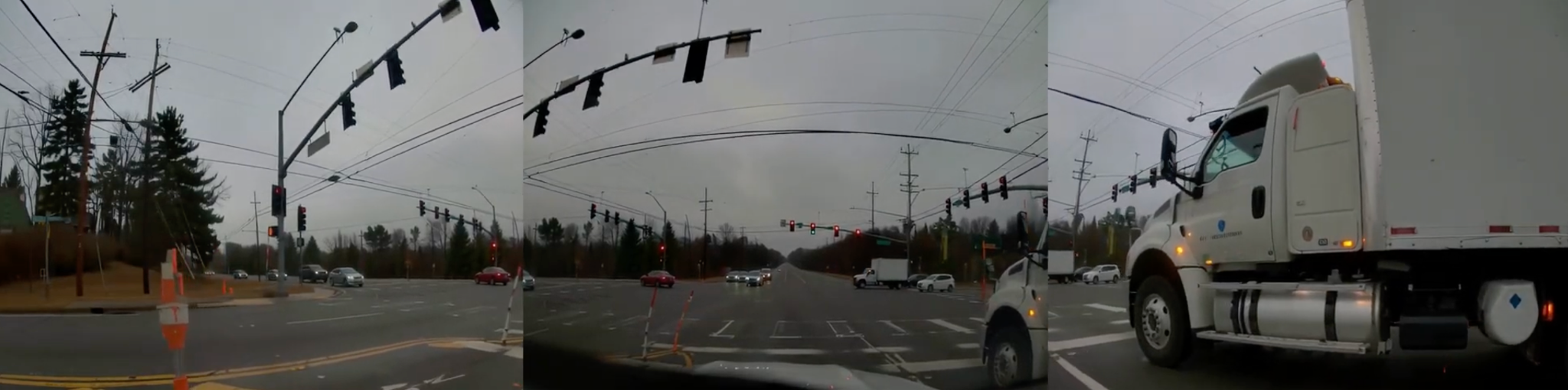
Oasis 3 is a generative world model: text prompt in, a living world out. A robot acts inside an infinite world in real time and receives realistic observations and feedback in return. The environment is not generated once and replayed — it continues to evolve in response to the robot's actions. Concretely:
- Promptable. Any environment from a single prompt. A snowy nighttime scene with the Eiffel Tower in the background used to mean weeks of expert effort in a classic simulator; in Oasis 3 it's a sentence. The same goes for the scenarios that matter most and occur the least: whiteouts and blizzards, mountain roads and tunnels, a camera obstructed by mud, steam, or debris.
- Hyper-realistic. Built on generative AI rather than hand-authored assets, Oasis 3 produces visuals at real-life quality, not video-game quality — closing the gap that keeps classically simulated training data from transferring to the real world.
- Infinite and interactive. Oasis 3 generates closed-loop interactions of unbounded length and complexity, in real time. Other world models cap out after a few minutes or fall back on less general approaches that can't capture the full complexity of the real world.
- Robot-native. Most world models take keyboard-and-mouse input — they're built for people. Oasis 3 is action-conditioned on robot actions and produces synchronized multi-camera observations as output, so a robot sees all around itself, the way it does in the real world.
- API-accessible. Until now, world models have been research demos or closed internal tools. Oasis 3 is the first you can simply call: API access from day one, ready to integrate into real robotics simulation pipelines.
Most world models pick a tradeoff: generality, length, or efficiency. Oasis 3 doesn't make you choose.
/A.03
How We Made It Happen
Live Stream Diffusion. Oasis 3 generates worlds autoregressively — frame by frame, with each new frame conditioned on the frames before it and on the robot's latest action. That action-conditioning is what closes the loop. Diffusion is a general solution that scales with data and isn't explicitly bounded the way representations like Gaussian splats are — which is what lets Oasis 3 generate unbounded, fully general worlds rather than replaying a fixed scene. The same real-time foundation behind Oasis 1 and Oasis 2 keeps generation coherent across long, unbounded sessions — correcting drift as it goes rather than letting it accumulate.
Multi-view consistency. Robots don't see the world through one camera. A geometry-aware architecture keeps Oasis 3's three synchronized camera views spatially consistent with each other, so the output reads as one continuous world rather than three independent videos — and the robot's full surround perception can be trained and evaluated faithfully.
Realistic data and post-training. Hyper-realism doesn't come for free. Oasis 3 is trained on real-world data and refined through dedicated post-training for realism, which is what separates its output from the video-game look of classic simulation.
DOS — the Decart Optimization Stack. World models will be used to simulate millions of hours, so usability lives or dies on efficiency. DOS delivers real-time, immediately interactive generation 100x more efficiently. Today, Oasis 3 runs at 22 FPS at 512×768×3, with under 200 ms of latency.
The system runs on CoreWeave’s purpose-built AI cloud and NVIDIA HGX B200 systems, with CUDA libraries including cuBLAS and cutlass for optimizations. The model was trained using the NVIDIA Physical AI Open Dataset on Hugging Face, supporting the performance needed for real-time simulation workflows.
/A.04
What You Can Do With It
Oasis 3 supports every step of the robot lifecycle (learning, practicing, testing) and unlocks a new class of physical AI workflows:
- Online reinforcement learning: use RL to train inside a generative world model: policies act, get feedback, and improve in a closed loop.
- Policy evaluation & validation: test against the exact scenarios that matter before deployment.
- High-fidelity teleoperation: Let human operators control robotic systems to create examples inside of Oasis 3 to create human expert training examples.
We're already working closely with industry leaders to bring general-purpose robots one step closer to reality.
/A.04
The Era Ahead
Oasis began as an interactive world model for gaming. With Oasis 1 and Oasis 2, we introduced real-time generation and interaction with virtual worlds; with Oasis 3, that same foundation now powers physical AI.
We're starting with autonomous vehicles and will generalize to other embodiments and industries — humanoids and manufacturing robots tackling dexterous manipulation, off-road and broader mobility systems where data is scarce. Our vision: every robot, no matter how simple or complex, trained and evaluated inside the Oasis world model — safely interacting with the full complexity of the real world inside a virtual one, at a scale the real world could never allow.
Every robot will be trained inside a world model. That era starts today.